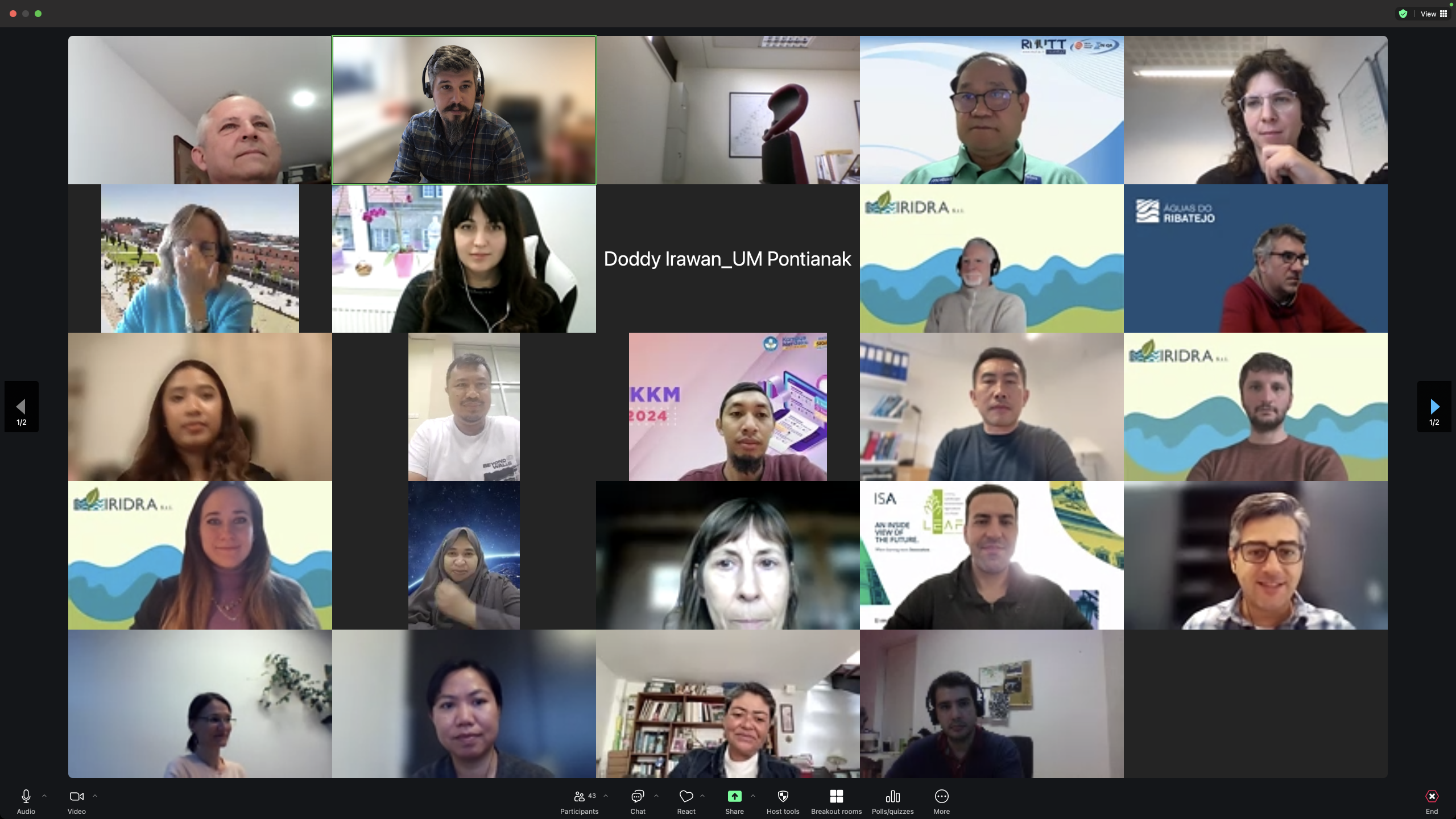
With nearly 50 participants joining online, the NEUTRAL4GS project launched in late January with a strong signal: this collaboration is ready to move. Over three days, researchers, engineers, and innovators from across Europe and the Global South connected to begin shaping sustainable, locally adapted solutions for urban water challenges.
The kickoff wasn’t just a run-through of work packages; it was a meeting of minds. Partners shared their expertise, perspectives, and ambitions — and one topic kept coming up: the case studies. These real-world examples became a central point of connection throughout the meeting. From wastewater treatment in Thailand to surface water contamination in Indonesia, groundwater challenges in Colombia and decentralized systems in Portugal, each site brought unique needs and opportunities for co-creation.
In group sessions, participants explored local constraints, shared ideas, and mapped out where technology, community needs, and nature-based solutions could align. These discussions weren’t just technical; they reflected the project’s core values of collaboration, adaptability, and mutual learning. It’s already clear that these sites will be more than testbeds — they’ll be spaces for shared innovation.
Throughout the three days, participants also shared expectations for technologies, research directions, and training needs, such as antibiotic resistance, microplastics, and stormwater reuse.
Despite the digital setting, the atmosphere was collaborative and forward-looking. Small-group discussions sparked ideas for webinars, breakthroughs, and field-ready technologies. As one partner put it, the project “already feels like a living network.”
A highlight of the meeting? The energy itself. “Starting the project and kicking off a new collaboration is really the highlight,” said Pedro Carvalho, project coordinator. “The high turnout showed strong engagement from all partners.”
With planning underway and the April workshop in Denmark already completed, NEUTRAL4GS is off to a strong start — not just innovating with nature but building a community that can make it work. We’ll take a closer look at the workshop highlights in our next article.
The project started on 1 January 2025 and has a duration of 48 months. It was submitted to the call HORIZON-MSCA-2023-SE-01; Type of Action: HORIZON-TMA-MSCA-SE. The EU contribution is EUR 740,600.00 This project has received funding from the European Union’s Horizon Europe under grant agreement No 101182652.